Stay human
Nov 17
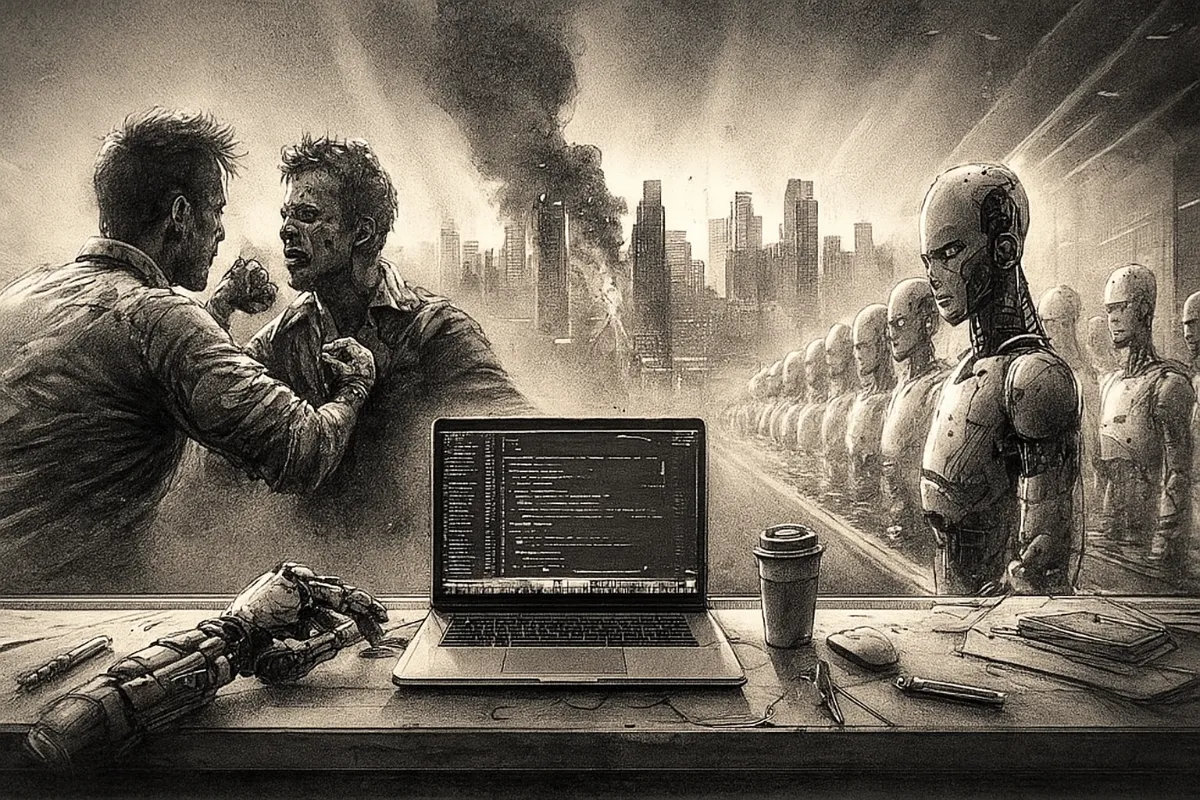
Fight club (1.999) begins with an unnamed man who has everything but feels nothing. Good job, clean apartment, perfect routine. Tyler Durden says the part that nobody wants to hear: Advertising has us chasing cars and clothes, working jobs we hate, so we can buy shit we don’t need. His crisis becomes chaos. The narrator starts an underground fight club to feel alive, again. The violence is not the point, the point is losing control and triying to take it back. And honestly, that feeling is growing fast in tech. It’s only after we’ve lost everything that we’re free to do anything. Before factories, a craftsman created a full piece from start to finish. Every object had personality and carried the identity of its creator. The industrial revolution broke this. Machines split the work into tiny steps and workers become operators and lost their connection to what they made. Think of Chaplin in Modern Times (1.936) obsessively tighting bolts on an assembly line until he goes insane. That scene reflected the reality: factories imposed discipline, shifts and disposable workers. Probably, today we see a similar process in software. For many years, programming was creative. We solved problems and built things with our own style. Now, genAI can write big parts of the code in seconds. Companies like the speed, but there’s a hidden cost. Devs start to feel less connected to the work. The risk isn’t that AI replaces us. The risk is to become irrelevant. If machines create more and we create less, our role becomes smaller. We become people who supervise code instead of people who design it. And that kills the sense of purpose. History shows a simple pattern. Every new invent, a new machine, brings more speed but also more distance between humans and the work they do. We still have time to avoid that. The answer is to act like digital craftsmen. Let AI write the boring part, fix small bugs and do repetitive work. But we should stay close to the decisions, the architecture and the ideas. That’s where humans add real value. That’s how we stay human. At the end of Fight club, the narrator stops running. He takes the control back. No drama, no illusion, just a clean break. We need something similar in tech. We don’t need chaos or buildings falling. Just a clear decision about the kind of work we want to do. It should push us to build better, think clearer and create things that no machine can copy. If you don’t shape the work, the work shapes you. Stay human. About Me I’m David, a Senior Software Engineer working at the edge of automation.